Transformer Rectifiers Market Set for Steady Expansion at 5.60% CAGR, Global Industry Forecast 2026–2032
Global Transformer Rectifiers Market Expands with Smart Power Conversion and Industrial Automation, Forecast 2026–2032
Press Release Disclaimer: This is a press release distributed through the XPR Media network. It has not been independently verified by our newsroom.
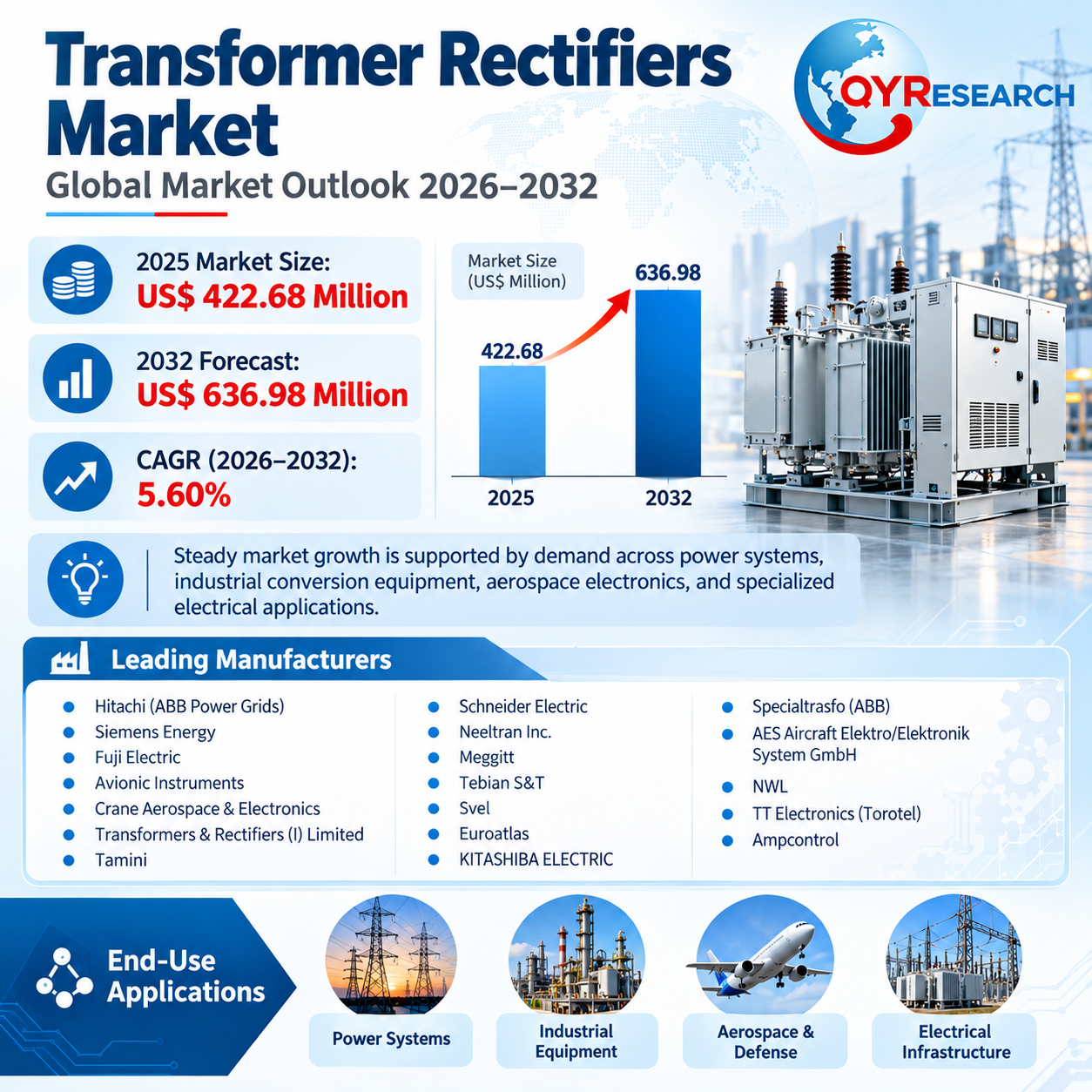

Global Transformer Rectifiers Market Expands with Smart Power Conversion and Industrial Automation, Forecast 2026–2032
PUNE, MAHARASHTRA, INDIA, September 28, 2026 /EINPresswire.com/ — Pune, India: According to the market dataset supplied for this release, the global Transformer Rectifiers market was valued at US$422.68 million in 2025 and is projected to reach US$636.98 million by the end of 2032, representing approximately 6.0% compound annual growth when calculated directly from those endpoints. The 2026–2032 outlook covers sales volume and revenue across air-cooled, oil-cooled and water-cooled transformer rectifier systems used in industrial processing, aviation, cathodic protection and additional specialized environments. The industry’s addressable opportunity extends from large industrial rectifier-transformer installations to compact, high-reliability aviation systems, giving manufacturers exposure to both capital-intensive industrial projects and highly engineered equipment markets. Current manufacturer portfolios confirm that rectifier systems span electrochemical processing, metal refining, hydrogen-related applications, aircraft electrical power, traction and corrosion-protection infrastructure.
Download Exclusive Research Report PDF Sample: (Including Full TOC, List of Tables & Figures, Chart) @ https://www.qyresearch.in/request-sample/machinery-equipment-global-transformer-rectifiers-market-report-history-and-forecast-2021-2032
Why This Market Matters:
Transformer rectifiers matter because numerous industrial and transportation systems ultimately require controlled DC power even when the available electrical supply is AC. Their role is particularly important where power quality, current stability, voltage control, reliability, galvanic isolation or continuous operation directly affects production economics and asset integrity. In aluminum electrolysis, Hitachi Energy notes that rectifier transformers may be integrated into sophisticated multi-pulse rectiformer systems; in electrochemical operations, manufacturers supply large DC power systems for chemical, metal-refining and hydrogen-related processes; and in electrostatic precipitators, the U.S. Environmental Protection Agency describes transformer-rectifier sets as the power supplies that energize discharge electrodes used to charge particles for collection. These varied applications make the market strategically relevant to manufacturing, environmental control, transportation and infrastructure operators.
Market Driving Growth and Restraint:
Market growth is being supported by industrial electrification, modernization of production plants, continued infrastructure investment, aerospace electrical-system demand, corrosion-protection requirements and specialized electrochemical processes. Global industrial activity remains heavily concentrated in regions with major metals and manufacturing footprints; Asia and Oceania, for example, produced 690.1 million tonnes of crude steel during the first half of 2026, illustrating the scale of the region’s industrial base, while ICAO expects Asia-Pacific air traffic to lead long-term passenger growth. At the same time, restraints include capital intensity, long qualification cycles, customized engineering requirements, commodity-price volatility, project delays and competition from alternative power-electronics architectures in applications where lighter or more modular conversion technologies can substitute for conventional transformer rectifier configurations.
Emerging Trends & Dynamics:
One of the most important dynamics through 2032 is expected to be the transition from stand-alone electrical hardware toward digitally observable power-conversion assets. Buyers are increasingly considering monitoring, alarms, remote control, condition assessment, maintainability and system integration during equipment specification. Another trend is growing specialization: aviation applications prioritize low weight and stringent electrical performance, cathodic-protection systems prioritize environmental ruggedness and controlled DC output, while electrochemical and metallurgical installations require very high currents and customized transformer-rectifier integration. Industrial decarbonization and expanding electrolysis applications can provide an additional opportunity because electrochemical processes depend on substantial DC power infrastructure. The U.S. Department of Energy identifies electrolysis as a pathway for producing hydrogen using electricity, while specialized transformer suppliers already list hydrogen among their DC-power application areas.
Market Challenges:
A major strategic challenge is the absence of a single standardized product architecture across end-use industries. A transformer rectifier designed for an aircraft has fundamentally different weight, voltage, certification and cooling priorities from a unit used in an aluminum smelter or a cathodic-protection installation. This fragmentation raises engineering costs, lengthens qualification processes and can limit economies of scale. Customers also expect long operating lives, creating pressure on suppliers to provide replacement parts, repair, retrofit and modernization support years after commissioning. At the same time, electrical-equipment supply chains must keep pace with broader investment in electrification and grid infrastructure. The IEA has emphasized the scale of upgrades required across electricity networks, reinforcing competition for transformer manufacturing capacity, engineering resources and critical electrical components.
Key Business Opportunities:
The strongest opportunities are likely to emerge where suppliers combine hardware with engineering, digital monitoring, maintenance, retrofit and lifecycle support. Industrial customers represent opportunities for replacement of aging transformer rectifier equipment, efficiency improvements, capacity expansion and process electrification, while aerospace manufacturers require qualified power-conversion systems for new platforms and fleet upgrades. Cathodic protection offers recurring opportunities across pipelines, storage tanks, marine infrastructure and other metallic assets requiring impressed-current corrosion control. Electrochemical processing, hydrogen projects, metal refining and specialized heating or plasma applications create additional demand for engineered high-current DC systems. Suppliers capable of providing complete transformer-rectifier packages, factory testing, remote diagnostics and aftermarket service can therefore pursue a larger share of customer lifecycle expenditure rather than competing only for original equipment sales.
Market Segmentation:
The global Transformer Rectifiers market is segmented by type into Air-Cooled Transformer Rectifiers, Oil-Cooled Transformer Rectifiers and Water-Cooled Transformer Rectifiers, with equipment selection determined by power level, thermal load, installation environment, maintenance preferences, space constraints and operating conditions. By application, the supplied study classifies demand into Industrial Process, Aircraft, Cathodic Protection and Other Applications. Air-cooled equipment can provide a compact and comparatively low-maintenance choice where ambient conditions permit, while oil-cooled systems are commonly engineered for demanding or higher-power environments. Aviation systems emphasize compact, lightweight and regulated electrical output, whereas cathodic-protection installations require stable DC power and may add hazardous-area enclosures, automatic potential control and remote monitoring.
Regional Market Insights:
Asia-Pacific represents an important strategic demand center because of its large industrial manufacturing base, metals production, infrastructure development and growing aviation activity; World Steel Association data continue to show Asia and Oceania accounting for the majority of reported global steel production, while ICAO expects the region to lead long-term air-traffic expansion. North America offers opportunities in industrial modernization, aerospace, corrosion protection, energy infrastructure and specialist high-current DC applications, supported by an established base of transformer rectifier and aerospace-power manufacturers. Europe combines mature industrial demand with electrification, infrastructure modernization, transportation and decarbonization initiatives; in June 2026, EU member states backed measures aimed at modernizing and expanding European energy infrastructure. Middle East, Latin America and other developing markets offer project-driven opportunities tied to metals, petrochemicals, pipelines, infrastructure and industrial expansion.
Competitive Landscape —
Key Players Are Investing In: Competition is shifting toward manufacturing capacity, engineering customization, power density, energy efficiency, thermal performance, digital monitoring, testing capabilities and lifecycle service. Hitachi Energy remains active in specialized rectifier transformers and has expanded broader transformer manufacturing capacity, while specialist suppliers such as Neeltran emphasize integrated transformer-and-rectifier engineering and full-current/full-voltage factory testing. Aerospace specialists including Avionic Instruments and Crane Aerospace & Electronics maintain dedicated aircraft transformer rectifier portfolios with multiple output ratings and power configurations. Specialtrasfo continues to develop customized industrial transformer products and announced a new rectifier transformer in 2026. Consolidation also changes competitor naming: the former Hitachi ABB Power Grids business has operated as Hitachi Energy, while Meggitt has been part of Parker Aerospace since 2022.
Major Global Manufacturers Include: Hitachi Energy | Siemens Energy | Fuji Electric | Avionic Instruments | Crane Aerospace & Electronics | Transformers & Rectifiers (India) Limited | Tamini | Schneider Electric | Neeltran Inc. | Parker Meggitt | Tebian Electric Apparatus/TBEA | SVEL | Euroatlas | Kitashiba Electric | Specialtrasfo | AES Aircraft Elektro/Elektronik System GmbH | NWL | TT Electronics/Torotel | Ampcontrol. This list reflects the competitive universe supplied for the study, with current corporate naming used where ownership or branding has materially changed. Hitachi Energy’s current identity replaced Hitachi ABB Power Grids, Parker Meggitt is now part of Parker Aerospace, and Specialtrasfo presents itself today as a family-owned independent industrial transformer manufacturer rather than an ABB company.
Important Questions Answered included in the Report:
(1) What is the global Transformer Rectifiers market size?
(2) What is driving growth in the Transformer Rectifiers market?
(3) Which Transformer Rectifier type is used most widely?
(4) Which industries use Transformer Rectifiers?
(5) Which region offers strong growth potential through 2032?
(6) What technology trends will shape the market?
(7) Who are the key companies in the market?
Who Should Buy This Report?
The Global Transformer Rectifiers Market Report 2026–2032 is designed for investors, industrial manufacturers, electrical equipment suppliers, aerospace companies, infrastructure developers, engineering consultants and market research professionals. Investors can use its market forecasts and competitive analysis to assess opportunities. Manufacturers can evaluate product requirements, application demand and competitive positioning. Procurement teams and industrial operators can examine the supplier landscape, while researchers and business development professionals can explore technological developments, regional demand and potential market entry opportunities.
For Further insights and Detailed Reports, Visit: https://www.qyresearch.in/report-details/8906514/Global-Transformer-Rectifiers-Market
About QYResearch
QYResearch founded in California, USA in 2007. It is a leading global market research and consulting company. With over 19 years’ experience and professional research team in various cities over the world QY Research focuses on management consulting, database and seminar services, IPO consulting (data is widely cited in prospectuses, annual reports and presentations), industry chain research and customized research to help our clients in providing non-linear revenue model and make them successful. We are globally recognized for our expansive portfolio of services, good corporate citizenship, and our strong commitment to sustainability. Up to now, we have cooperated with more than 70,000 clients across five continents. Let’s work closely with you and build a bold and better future.
Contact US
Ankit Jain – Director, Global Digital Marketing
QY Research, INC.
India Office –
315Work Avenue, Raheja Woods, Kalyani Nagar,
Pune, Maharashtra 411006, India
Web – https://www.qyresearch.in
Email- ankit@qyresearch.com
Ankit Jain
QY Research India
+ +91 8149736330
ankit@qyresearch.com
Legal Disclaimer:
EIN Presswire provides this news content “as is” without warranty of any kind. We do not accept any responsibility or liability
for the accuracy, content, images, videos, licenses, completeness, legality, or reliability of the information contained in this
article. If you have any complaints or copyright issues related to this article, kindly contact the author above.

Media gallery