From Zero to 200 Cups a Day: How a Solo Entrepreneur Built a 24/7 Coffee Business in 8 Months with AI Robot Barista
SOFIA, SOFIA, BULGARIA, September 2, 2026 /EINPresswire.com/ -- Shenzhen-based entrepreneur leverages autonomous coffee
Press Release Disclaimer: This is a press release distributed through the XPR Media network. It has not been independently verified by our newsroom.
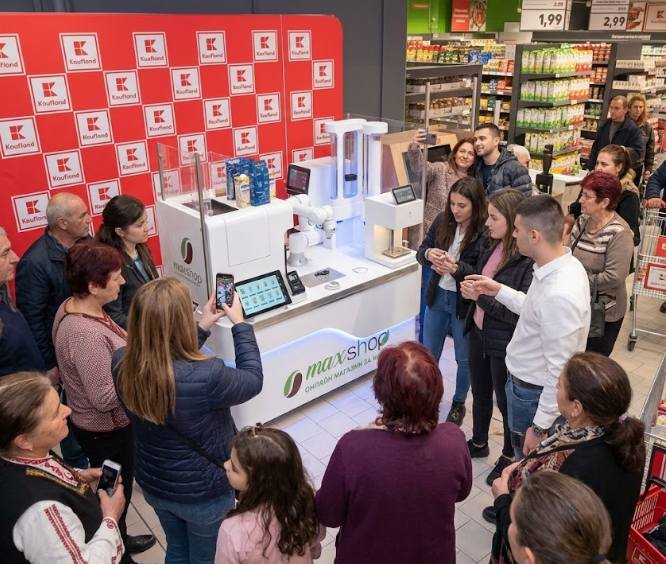

SOFIA, SOFIA, BULGARIA, September 2, 2026 /EINPresswire.com/ — Shenzhen-based entrepreneur leverages autonomous coffee robot technology to launch profitable unmanned café in Sofia, Bulgaria, achieving payback in under 9 months.
When Dimitar Petrov, a 34-year-old former software engineer from Sofia, decided to leave his corporate job in late 2025, he had no food service experience, no barista training, and no desire to hire staff. Eight months later, his AI-powered coffee kiosk serves over 200 cups daily, operates 24/7, and generates net monthly profits exceeding €4,200 — all without a single employee on site.
Petrov’s story reflects a growing trend in the global food service industry: solo entrepreneurs using autonomous beverage robots to build scalable, passive-income businesses. The AI coffee robot market, valued at $2.8 billion in 2026 according to Verified Market Reports, is enabling a new class of business owner who trades traditional labor-intensive operations for technology-driven automation.
“I looked at opening a traditional café,” Petrov explained. “The numbers were brutal: €85,000 in buildout costs, €3,800 monthly rent, two baristas at €1,600 each, plus utilities, insurance, inventory management. I’d need to sell 350 cups daily just to break even. The math didn’t work for a solo operator.”
Instead, Petrov discovered the AI coffee robot model — a compact, fully autonomous kiosk that grinds beans, brews espresso, adds milk and flavors, and serves completed drinks through a touchscreen interface. After evaluating multiple suppliers, he selected a system from Moocoo, a Shenzhen-based manufacturer with deployments in over 60 countries.
“The Moocoo unit was the only system I found that combined true autonomous operation with a realistic price point for a solo entrepreneur,” Petrov said. “The payback projection was 10-14 months. I achieved it in under nine.”
The Setup: From Decision to Deployment in 45 Days
Petrov’s timeline from initial research to first sale was remarkably compressed. In January 2026, he attended a food technology trade show in Berlin where he saw multiple AI coffee robot demonstrations. By February, he had submitted his order. The machine arrived in Sofia in early March, and after a two-day installation and calibration process, his kiosk was operational in a high-traffic shopping center corridor.
“The location was critical,” Petrov explained. “I negotiated a revenue-sharing agreement with the mall — 18% of gross sales — instead of paying fixed rent. This eliminated my biggest fixed cost and aligned the landlord’s incentive with my success. The mall gets more foot traffic when people see the robot; I pay less when business is slow.”
The total startup investment came to €47,500, including the robot, site preparation, initial inventory, and three months of operating capital. This compared favorably to the €85,000+ required for a traditional café buildout, according to industry benchmarks from the Specialty Coffee Association.
The Numbers: 200 Cups Daily at 78% Gross Margin
Eight months into operations, Petrov’s results have exceeded his conservative projections:
Daily volume: 210 cups average (peak: 280 on weekends)
Average ticket: €4.80
Monthly gross revenue: €30,240
Gross margin: 78% (€23,587)
Location commission (18%): €5,443
Operating costs (utilities, maintenance, supplies): €2,100
Monthly net profit: €4,200–€5,100 (depending on season)
“The gross margin is what makes this model work,” Petrov noted. “My cost per cup — beans, milk, cup, lid, sleeve — is about €1.05. I sell for €4.80. That’s a 78% gross margin. Compare that to a restaurant at 60-65%, or a food truck at 55-60%. The economics are fundamentally different.”
The AI system maintains consistency that human baristas struggle to match. Petrov’s kiosk delivers pour accuracy within ±1%, meaning every cup of latte tastes identical whether it’s ordered at 7 AM or 2 AM. The machine’s 6-axis robotic arm and precision grinding system produce espresso quality that has earned a 4.7-star average rating across delivery platforms.
“People are surprised by the quality,” Petrov said. “They expect vending machine coffee. They get café-quality espresso drinks. The repeat customer rate is 68% — higher than most traditional cafés.”
The Passive Income Model: True Hands-Off Operation
What attracted Petrov to the AI coffee robot model was the promise of passive income. Eight months in, the reality has matched the pitch.
“I spend about 90 minutes per week on the business,” Petrov said. “I check inventory levels remotely through the cloud dashboard, review sales reports, and visit the site twice a week to restock beans, milk, and supplies. The machine handles everything else — grinding, brewing, milk steaming, latte art, cleaning cycles, even self-diagnostic alerts when something needs attention.”
The system’s remote monitoring capability allows Petrov to track real-time performance from his phone. He receives automated alerts for low inventory, temperature deviations, and maintenance requirements. The machine performs daily cleaning cycles automatically and schedules weekly deep cleans during low-traffic hours.
“The 24/7 operation was a game-changer,” Petrov explained. “Traditional cafés close at 8 or 9 PM. I capture the late-night crowd — students, shift workers, people leaving restaurants. That’s 30-40% of my daily volume, and it’s pure profit because there’s no additional labor cost.”
Scaling the Model: From One Kiosk to Three
Buoyed by his success, Petrov has deployed two additional Moocoo units in Sofia — one in a university district and another near the central train station. He’s now evaluating locations in Plovdiv and Varna for his fourth and fifth units.
“Once you prove the model with one machine, scaling is straightforward,” Petrov said. “The hardest part was the first unit — learning the location dynamics, optimizing the menu, building the customer base. Now I have a playbook. Each new unit takes about 30 days to reach steady-state volume.”
Petrov’s expansion strategy focuses on high-traffic, extended-hours locations: shopping centers, university campuses, transportation hubs, and entertainment districts. He targets locations with foot traffic above 10,000 daily and operating hours extending past 10 PM.
“The AI coffee robot model works best in environments where traditional cafés can’t compete,” Petrov explained. “A barista won’t work the 2 AM shift for what I pay. A robot will. That’s not displacement — it’s serving customers who otherwise wouldn’t be served.”
Industry Context: The Rise of the Solo Automation Entrepreneur
Petrov’s story is part of a broader trend identified by market researchers. The global AI coffee robot market is projected to reach $8.9 billion by 2030, growing at 22.4% CAGR, according to Fortune Business Insights. A significant portion of this growth is driven by solo entrepreneurs and small operators deploying single or multiple units as passive-income assets.
“The democratization of beverage automation is the story of 2026,” said industry analyst Maria Chen of FoodTech Research. “Three years ago, autonomous coffee robots cost $120,000+ and required corporate-level investment. Today, systems from manufacturers like Moocoo are priced for individual entrepreneurs, with financing options that make the economics work for a first-time business owner.”
The model appeals particularly to professionals seeking exit from corporate employment. Petrov’s background in software engineering gave him comfort with technology, but he emphasized that technical expertise isn’t required.
“If you can use a smartphone, you can operate this machine,” Petrov said. “The AI handles the coffee. The cloud dashboard handles the business intelligence. I handle restocking and smile at customers when I visit. That’s it.”
Advice for Aspiring Coffee Robot Entrepreneurs
Petrov offers three recommendations for others considering the AI coffee robot model:
Location before equipment. “Spend 80% of your pre-launch time on location scouting. The machine is proven technology — it works. The variable is foot traffic and site economics. A mediocre machine in a great location outperforms a premium machine in a weak location every time.”
Negotiate revenue-sharing, not fixed rent. “Fixed rent is a killer for a new business. Revenue-sharing aligns incentives and reduces your downside risk. Most shopping centers will negotiate this for a novel attraction like a robot café.”
Start with one machine, prove the model, then scale. “Don’t buy five machines at once. Buy one, learn the business, optimize your operations, then expand with data. My second unit was profitable in 45 days because I applied lessons from the first.”
About Moocoo
Moocoo is a Shenzhen-based technology company specializing in AI-powered autonomous beverage robots. The company’s product line includes coffee robots, bubble tea robots, ice cream robots, and bartender robots, deployed across 60+ countries. Moocoo holds CE, FCC, and ISO 9001 certifications, with 70+ patents covering robotic arm precision, AI recipe management, and cloud fleet operations. For more information, visit https://www.moocoo.com/.
Moocoo Technology
Shenzhen Moocoo Technology Co., Ltd
+852 6903 1935
info@moocoo.com
Legal Disclaimer:
EIN Presswire provides this news content “as is” without warranty of any kind. We do not accept any responsibility or liability
for the accuracy, content, images, videos, licenses, completeness, legality, or reliability of the information contained in this
article. If you have any complaints or copyright issues related to this article, kindly contact the author above.

Media gallery